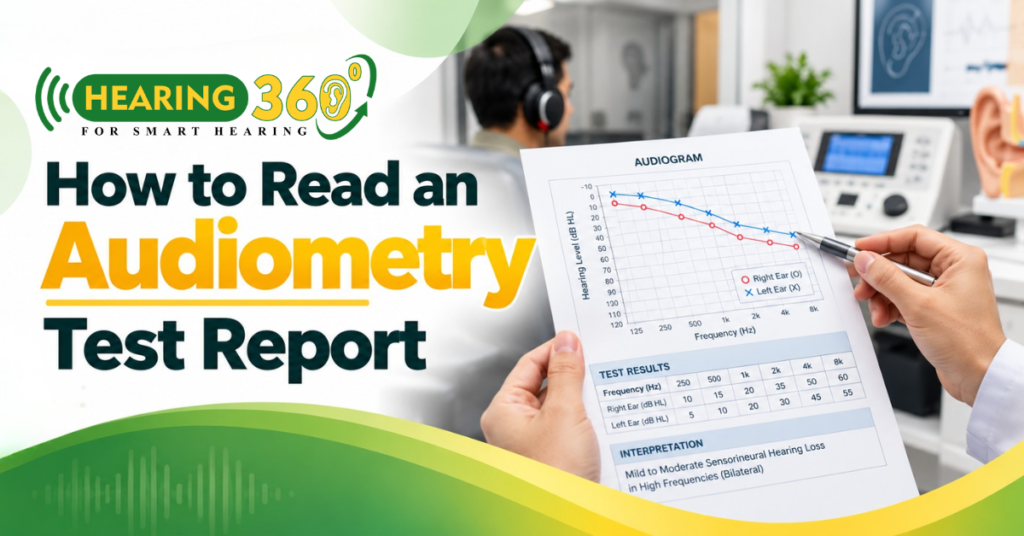
What does your audiometry test report tell you? You go for a hearing test and you’ll notice the audiologist checks your hearing twice: once through headphones, and once through a small vibrating device pressed behind your ear.
That second test isn’t a formality. The difference between these two results, known as the air-bone gap, tells a specific story about where a hearing problem might be starting.
This piece breaks down what that gap means, how it’s measured, and why one number on an audiogram should never be read on its own.
What an Audiometry Test Report Actually Tells You About an Air-Bone Gap
An air-bone gap is the difference between how well you hear through air conduction and how well you hear through bone conduction, measured at the same frequency.
It’s not a diagnosis. It’s a clue that points toward where sound transmission might be breaking down.
Air Conduction vs Bone Conduction
Air conduction testing sends sound through headphones. It travels through your outer ear, across the eardrum, through the tiny middle-ear bones, and into the cochlea. Bone conduction testing skips most of that path.
A small oscillator placed behind the ear sends vibrations directly through the skull to the cochlea, largely bypassing the outer and middle ear.
Comparing the two matters because it separates two very different questions: is sound getting blocked on its way in, or is the cochlea itself struggling to process it?
How the Gap Is Calculated
There’s a simple formula that calculates the gap:
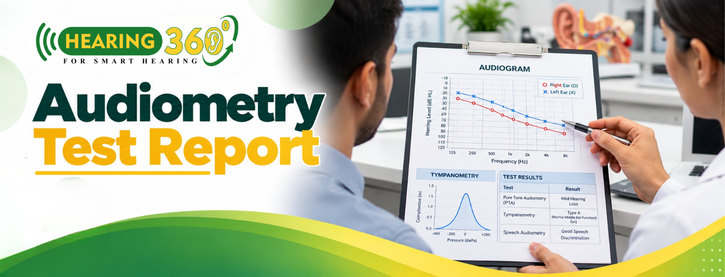
Air conduction threshold – Bone conduction threshold = Air-bone gap
For example, if the threshold of air conduction at a certain frequency is 45 dB HL and the bone conduction threshold is 15 dB HL. The gap is 30 dB.
That calculation happens frequency by frequency, not once for the whole audiogram. A gap at 500 Hz can look completely different from a gap at 4 kHz, and treating the audiogram as if it has a single ABG value misses important detail.
Why One Number Isn’t the Full Story
A real gap suggests a conductive component. However, the interpretation depends on different things like which frequency it appears in, how dependable the thresholds were, if masking was required, and what tympanometry and otoscopy show.
There’s no single cutoff that applies universally.
Clinical references use somewhat different thresholds depending on context, and current research has also flagged that apparent gaps aren’t always real.
How to Read Patterns in an Audiometry Test Report
One airborne gap value means much less than the pattern it represents. Audiologists read the entire audiogram shape before making any conclusions.
Conductive hearing loss shows air conduction thresholds which are worse than bone conduction thresholds. This gap points to:
- Problems with the small middle-ear bones
- Ear-canal blockage including wax
- Middle-ear fluid
- Damage in eardrum
- Otosclerosis
An audiogram can suggest a conductive issue is present, but it generally can’t identify the exact cause. Otoscopy and tympanometry fill in that piece.
Sensorineural hearing loss looks different. A similar amount elevates both air and bone conduction thresholds, so there’s little or no meaningful gap. The issue isn’t sound getting blocked; it’s the inner ear or hearing nerve not processing it well.
Mixed hearing loss is a combination of both. Bone conduction thresholds increase, showing a sensorineural component, and air conduction is even worse. This keeps the gap alive.
Identifying the pattern is important because it changes whether the follow-up makes sense. This is where a hearing health care clinic becomes necessary.
When reading an audiometry test report, these cross-checks help determine whether an apparent air-bone gap is clinically meaningful.
You have to read the patterns together, instead of reacting to a single threshold in isolation. This is what turns a printout into something actionable.
Masking, Cross-Checks, and Why Context Changes the Answer
Bone conduction has a quirk that trips up a lot of people reading their own results: vibration travels through the skull efficiently enough that it can reach both cochleae, not just the one being tested.
An unmasked bone conduction result doesn’t always represent the ear you think it does.
Masking noise is added to the non-test ear specifically to prevent this crossover from distorting the result. Get it wrong, and the picture shifts:
- Undermasking lets the non-test ear respond anyway, hiding a real problem.
- Overmasking can suppress the test ear’s true response, creating a gap that isn’t really there.
This is one reason apparent gaps sometimes don’t hold up. An air-bone gap can be a false finding, caused by test variability, oscillator placement, occlusion effects, or measurement issues specific to certain frequencies.
Research has pointed to 250 Hz and 4 kHz as spots where false gaps show up more often. This is exactly why a single unusual number at one frequency shouldn’t be treated as conclusive.
That’s why any competent hearing care clinic cross-checks an apparent gap against other findings before concluding:
- Otoscopy: checks for visible blockage or eardrum abnormalities
- Tympanometry: evaluates how the eardrum and middle ear are moving
- Speech audiometry: adds functional information pure tones don’t capture
- Acoustic reflex testing: contributes another data point on middle-ear function
No single test stands in for the whole picture. An air-bone gap should never be read as proof of a specific ear condition without checking it against these other results.
What This Means for Your Next Step
If an audiometry test report shows a conductive component, the next step usually isn’t a hearing aid; it’s ruling out something treatable first.
Wax, fluid, or a middle-ear issue often responds to medical treatment rather than amplification.
That’s part of why a hearing care clinic will typically hold off on rehabilitation decisions until otoscopy, tympanometry, and the audiogram all line up.
Rehabilitation options, when they’re appropriate, depend on the cause, the degree of loss, whether it’s stable, and what the patient actually needs day to day.
A conductive component that’s medically treatable calls for a different path than a sensorineural loss that isn’t.
The short version: an air-bone gap, the audiogram’s overall shape, otoscopy, tympanometry, and case history all need to be read together.
Any one of them alone tells an incomplete story.
When Should You Get a Hearing Assessment?
You don’t need to wait for a dramatic symptom. Worth booking an appointment if you notice:
- Trouble following speech in noisy rooms
- Repeatedly turning the volume up
- A history of recurring ear infections or fluid
- Sudden or noticeable changes in hearing
- A persistent blocked or full feeling in one ear
- Previous test results that came back abnormal
Sudden hearing changes deserve prompt medical attention rather than a wait-and-see approach; a delayed evaluation can matter for how treatable the cause turns out to be.
Reading your own audiogram can only take you so far.
If your results mention an air-bone gap, the next useful step is having it reviewed alongside otoscopy and tympanometry findings by someone trained to interpret the full pattern, which is exactly the kind of assessment a hearing health care clinic is set up to provide.
Check out Hearing 360 Degree’s services and book a test as per your doctor’s recommendation.
FAQs
- What do the symbols and lines on an audiometry test report mean?
Audiograms use standard symbols to show air and bone conduction results for the right and left ears. Understanding these symbols helps identify which thresholds belong to each ear and how the results are plotted.I - What does dB HL mean on an audiometry test report?
dB HL stands for decibels hearing level. It is the scale used to show the intensity of sound needed for a person to detect different frequencies during a hearing test. - Can an audiometry test report show hearing loss in only one ear?
Yes. Hearing thresholds can differ significantly between the two ears. An audiologist compares the right and left ear results to determine whether hearing loss is unilateral, asymmetric, or present in both ears. - How long is an audiometry test report valid?
An audiometry test report represents hearing ability at the time of testing. If hearing changes, new symptoms develop, or treatment is being considered, an audiologist may recommend repeating the assessment rather than relying on an older report.