
A pure tone audiometry test report can look like a page of dots and lines. You see numbers and a graph, but no clear answer.
That is frustrating when you only want to know how well you hear.
This guide explains your results in plain English.
You will learn how to read the graph, what each hearing loss level means, and what to do next.
If you searched for a PTA test for ear results guide, you are in the right place.
How to Read a Pure Tone Audiometry Test Report
The test finds the quietest tones you can hear at different pitches.
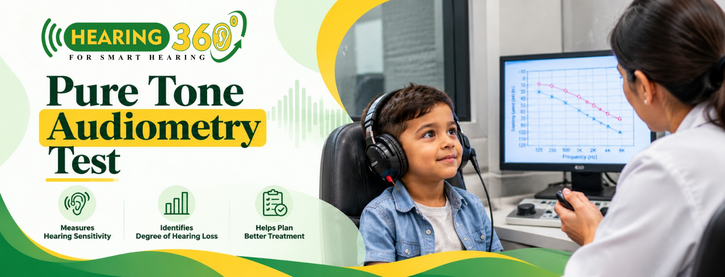
The audiologist records each result on a graph called an audiogram. Each ear gets its own set of results.
What do Hz and dB HL mean?
The graph has two axes.
| Audiogram element | What it means |
| Horizontal axis (Hz) | Pitch, from low to high |
| Vertical axis (dB HL) | The softest level you heard the tone |
| Lower number | Better hearing at that pitch |
| Higher number | A louder tone was needed |
Zero dB HL does not mean silence. It is a standard reference point. Some people hear tones below it.
The graph also shows your softest detected tones. It does not show how much volume you can tolerate.
Which line is which ear?
Most reports use O for the right ear and X for the left.
Some reports use colours instead.
Red often marks the right ear and blue the left.
Check the legend on your own report.
What does the pattern show?
Each point is a threshold at one pitch.
Joined together, the points form a pattern. You may hear low pitches well but miss high ones.
That is why one number never tells the full story. Look at the whole line.
Hearing Loss Levels Explained: What Your Thresholds Mean
Hearing loss levels depend on your thresholds in dB HL.
The table below uses one commonly used clinical scale.
Other guidelines split or combine the groups differently.
Age and the calculation method also matter. Ask your audiologist which scale they use.
| Hearing level | Threshold range (dB HL) |
| Normal hearing | −10 to 20 |
| Mild hearing loss | 21–40 |
| Moderate hearing loss | 41–55 |
| Moderately severe hearing loss | 56–70 |
| Severe hearing loss | 71–90 |
| Profound hearing loss | 91 or higher |
Normal hearing
Adult thresholds up to about 20 dB HL usually count as normal. Some guides use 25.
A normal result shows good sensitivity to soft tones. It does not rule out every problem.
You may still find it difficult to follow speech in crowded, noisy spaces.
If the symptoms are constant, ask for further follow-up tests.
Mild hearing loss
You require louder tones to hear sound. There’s a chance you may miss out on soft speech or parts of a conversation.
Group chats and background noise feel harder.
The impact usually depends on the pitches that are affected and the way you live.
Moderate hearing loss
You need louder sounds. Speeches at normal level can be difficult to follow, particularly from afar.
Noisy rooms become prominent.
An expert audiologist can decide on communication strategies and whether hearing support can help.
Moderately severe loss is somewhere between moderate and severe.
Severe hearing loss
Severe loss means much louder sounds are needed. Daily conversation is hard without support.
Profound loss is the most severe category.
Many environmental sounds and much of speech may be hard to access.
Further tests and rehabilitation options are usually discussed.
A threshold alone cannot predict your speech understanding.
It cannot pick a device for you either.
A quick example
Say your right ear shows 15 dB HL at 500 Hz, 30 dB HL at 2000 Hz, and 60 dB HL at 4000 Hz.
The line slopes downward. Low pitches fall in the normal range.
Mid pitches show mild loss. High pitches show moderately severe loss.
A person with this pattern may hear vowels well but miss sounds like s, f, and t. Speech then sounds muffled, not quiet.
This is why people say, “I hear you, but I can’t understand you.”
This example is for illustration only. It is not a diagnostic tool.
Why levels differ across pitches
Your loss may not be the same at every pitch. Common shapes include:
- Flat: Thresholds are the same throughout the pitches
- High-frequency sloping: Hearing becomes worse at higher pitches
- Rising: Lower pitches are weaker than higher ones
- Notched: A dip is observed at a narrow range of pitches
One label cannot capture the full pattern. Shapes guide the audiologist.
They cannot confirm the cause alone.
When the ears differ
Symmetrical loss means both ears are similar. Asymmetrical loss means one ear hears better.
A PTA test for ear problems plots both ears separately, so differences show up clearly.
The gap may appear at some pitches or across the range.
A notable difference needs review by a qualified professional.
It may call for further tests.
Does the audiogram show the type of loss?
Partly. Your pure-tone audiometry test also records bone conduction.
Air conduction sends sound through the ear canal.
Bone conduction sends it through the skull. Comparing the two gives general patterns.
| Type | General pattern |
| Conductive | Air results are poorer than bone results (an air–bone gap) |
| Sensorineural | Both are raised, with no significant gap |
| Mixed | Both are raised, with a gap present |
These are general patterns only. The audiologist also reviews your history, an ear examination, and other tests.
What to Do After Reading Your Results
Can an audiogram diagnose hearing loss alone?
No. It shows the degree, pattern, and possible type of loss. It does not name every cause.
It also misses parts of speech understanding.
Your audiologist may add speech audiometry or tympanometry. Share the full report with an audiologist or ENT specialist.

When should you seek more evaluation?
Persistent difficulty deserves attention, even with a normal report.
Big differences between ears also need review. Sudden hearing loss is different.
If it develops over hours or a few days, seek urgent medical care.
Do not wait for a routine appointment.
What happens if you have hearing loss?
Next steps depend on the type, degree, and pattern.
Options include a medical check, follow-up tests, communication strategies, hearing aids, or other rehabilitation.
Severity alone does not decide hearing aid suitability.
Mild loss does not automatically need one.
Each person needs an individual assessment.
Questions to ask your audiologist
- Which scale do you use for my hearing loss level?
- Is my loss the same in both ears?
- Which pitches are affected?
- Do I need speech audiometry or other tests?
- When should I retest?
Mistakes to avoid
- Reading only one number
- Comparing your report with someone else’s
- Ignoring symptoms because the result looks normal
- Guessing the cause on your own
- Delaying a repeat test when your hearing changes
Your pure tone audiometry test shows the degree and pattern of your hearing loss. It does not tell the whole story.
Read both ears and every pitch. Then talk to a professional.
Reading a PTA test for ear results this way helps you act early and ask better questions.
Hearing 360 Degree offers diagnostic hearing tests and hearing care options.
Book a consultation to review your report with an audiologist.
Frequently Asked Questions
What is a normal result on a hearing test like this?
Adult thresholds of about 0–20 dB HL are commonly considered normal. Some guidelines use 25 dB HL. Definitions vary.
What does 40 dB HL mean on my report?
It is the softest level you heard at one pitch. It may differ at other pitches or in your other ear.
Can one ear have more hearing loss than the other?
Yes. This is called asymmetry. A professional should review the full report.
Does mild hearing loss need a hearing aid?
Not automatically. It depends on your symptoms, listening needs, and test findings.
Can I have a normal result and still struggle to understand speech?
Yes. Pure-tone testing does not measure every part of speech understanding, especially in noisy places.
Should I repeat the test if my hearing changes?
Yes, in most cases. Timing depends on your symptoms and your clinician’s advice. Sudden hearing loss needs urgent assessment.