
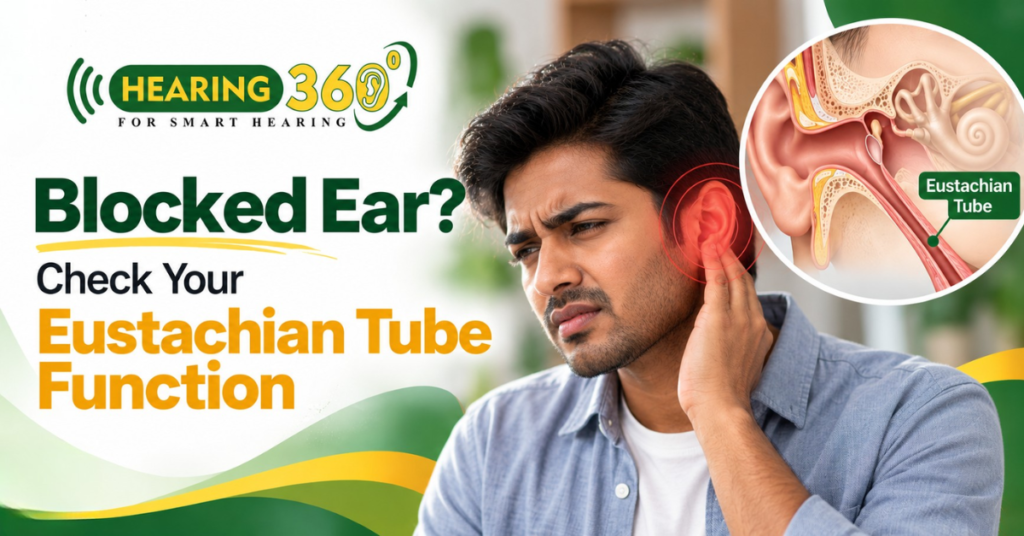
Your ear feels stuffed, like it’s underwater, and popping your jaw or yawning barely helps. If this happens after a flight, a cold, or for no obvious reason at all, a visit to a hearing health care clinic can help pinpoint what’s actually going on.
The cause isn’t always hearing loss. Often, it’s about pressure, not volume.
The Eustachian tube is a narrow passage that connects the middle ear back to the throat. Its job is to equalize pressure and drain fluid. When it isn’t working the way it should, your ears can feel blocked even though your hearing test comes back normal.
Our blog breaks down what that means, how it happens, and when it’s worth getting checked.
Blocked Ear: Beyond Earwax or Hearing Loss
Why does my ear feel blocked when I can still hear? Because fullness and hearing loss are two different problems.
Fullness usually points to pressure or ventilation issues in the middle ear, not damage to the inner ear or hearing nerve. You can hear reasonably well and still feel like your ear needs to pop.
Common signs that point toward a pressure-related issue rather than typical hearing loss include:
- Persistent fullness or pressure in one or both ears
- Muffled, “underwater” hearing that comes and goes
- Clicking noises while yawning or swallowing
- Trouble equalizing ears during flights, driving through mountains, or scuba diving
- Ear discomfort that lingers after a cold or sinus congestion
Occasional pressure changes, like on a descending flight, are normal and usually resolve within hours.
What’s worth paying attention to is when fullness sticks around for days or weeks, or keeps coming back after every cold.
That pattern suggests the tube isn’t resetting properly on its own. It’s a reasonable enough reason to have it looked at rather than waiting it out again.
Eustachian Tube Function and Middle-Ear Pressure Connection
How can Eustachian tube dysfunction lead to ear pressure? The tube opens for a while when you yawn or swallow. This lets air in and balances both sides of the eardrum.
When there’s a problem with the opening, air gets trapped, leading to uneven pressure building, and the eardrum cannot vibrate the way it needs to.
Different daily triggers interfere with this:
- Enlarged adenoids, more common in children, can physically block the opening
- Sinus and cold infections lead to swelling in the opening of the tube
- Fast altitude changes such as flying or driving across hills can outpace the tube’s adjusting capacity
- Allergies may trigger inflammation, often without a cold
Not every blocked-ear complaint traces back to the Eustachian tube.
Fluid buildup, earwax impaction, or even temporary changes in inner ear function can produce similar sensations. That’s exactly why guessing at the cause rarely helps long-term.
A visit to a hearing health care clinic allows a professional to narrow down whether pressure regulation, fluid, or something else is behind the discomfort.
This is a better approach instead of cycling through home remedies for a problem that needs a different kind of attention.
How a Hearing Health Care Clinic Assesses Eustachian Tube Function
What is an Eustachian Tube Function Test? It’s a diagnostic check that measures how well the Eustachian tube ventilates and equalizes pressure in the middle ear.
It’s typically done alongside other assessments, not as a standalone hearing check, since it’s evaluating tube function rather than hearing sensitivity itself.
When should you get an Eustachian Tube Function Test? It’s worth considering when:
- Feeling of fullness in ear stays for a few weeks
- Symptoms come back with allergy flare or cold
- Struggling to make pressure even during air travel
- Muffled hearing comes with clicking, popping and imbalance
- A standard hearing test comes back normal, but the fullness persists
Is an Eustachian Tube Function Test the same as a hearing test?
No. A pure-tone audiometry test measures how well you hear different pitches and volumes. An Eustachian Tube Function Test looks at pressure regulation and ventilation in the middle ear instead.
They answer different questions, which is why they’re often used together rather than one replacing the other.
At a facility like Hearing 360 Degree, this test sits alongside impedance audiometry, pure-tone audiometry, and speech audiometry as part of a broader diagnostic pathway.
The idea isn’t to run every test on every patient. It’s to match the right test to the symptoms someone actually describes, whether that’s a fullness complaint, a hearing complaint, or both together.
If pressure and muffled hearing keep returning, the more useful next step isn’t another round of ear drops or waiting it out.
It is checking the actual mechanism so that follow-up treatment addresses the actual cause rather than a mere symptom.
Considerations Before Assumptions
Here are certain points that you need to keep in mind:
- Children experience this differently. Enlarged adenoids or frequent colds make Eustachian tube issues more common in kids, and they may not describe fullness clearly, describing it instead as feeling funny in the ears.
- Self-treatment comes with limitations. Certain techniques like the Valsalva maneuver may offer relief for the time being but wouldn’t solve the underlying dysfunction pattern.
- Chronic fullness without pain needs attention. Pain is not the final yardstick for severity. It’s often not present with tube dysfunction. So, the absence of pain doesn’t rule it out.
- Results vary by cause. Someone with allergy-driven symptoms will need a different approach than someone with structural or anatomical factors, which is why a one-size-fits-all fix rarely works.
Getting an accurate read on what’s happening allows for a plan suited to the actual cause, rather than repeating the same temporary fixes each time symptoms flare.
A pressurized ear or blocked ear is just a symptom and not a complete diagnosis. This is rooted in allergies, congestion, attitude shifts or the Eustachian tube, which doesn’t equalize pressure the way it needs to.
Finding out which applies to you is what makes things move forward.
If fullness, muffled hearing, or popping keeps interrupting your day, don’t wait for it to resolve on its own again.
Book an evaluation with a hearing health care clinic that can run the right combination of tests and tell you exactly what’s driving the problem.
At Hearing 360 Degree, this kind of assessment is part of a broader diagnostic pathway that includes the Eustachian Tube Function Test, impedance audiometry, pure-tone audiometry, and speech audiometry, so the test matched to your symptoms is the one you actually get.
FAQs
- Can Eustachian tube dysfunction go away on its own?
Yes, often it does, especially when it’s tied to a cold or short-term congestion. Symptoms that persist beyond a few weeks or return frequently are less likely to resolve without evaluation. - Does Eustachian tube dysfunction cause hearing loss?
It can cause temporary, mild muffling due to pressure imbalance, but this is usually different from permanent hearing loss. A hearing test alongside an Eustachian Tube Function Test can clarify which is happening. - Is Eustachian tube dysfunction more common in children or adults?
It’s more common in children because their Eustachian tubes are shorter and more horizontal, making drainage harder. Adults can still develop it, often triggered by allergies, sinus issues, or altitude exposure. - What happens during an Eustachian Tube Function Test?
The test typically measures pressure changes in the ear canal as you swallow or perform specific movements, tracking how well the tube opens and equalizes pressure. It’s non-invasive and doesn’t require any recovery time.