
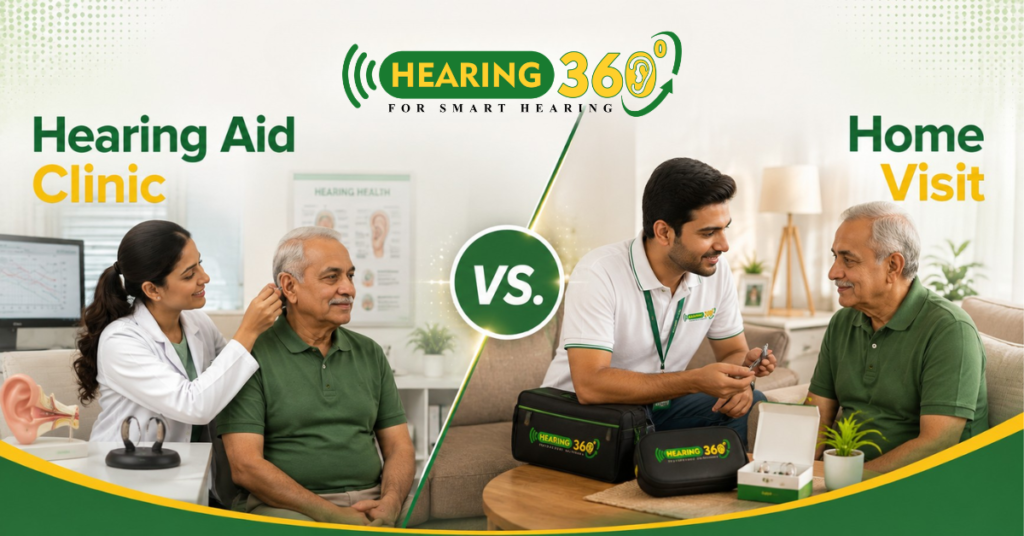
Should you book a hearing aid clinic visit across town, or let the audiologist come to you instead?
For most Kolkata families, the honest answer isn’t one or the other; it depends on what stage of the hearing-care journey you’re at.
Home visits and clinic appointments both have real strengths. The trick is knowing which one fits your situation right now, not picking a side and sticking with it forever.
This isn’t really an either-or decision. Most families end up using both at different points, one option for the deeper evaluation, and the other for everything that follows.
Hearing Aid Clinic at Home vs In-Clinic: What Can You Actually Get?
Before comparing the two, it helps to know what each option actually includes. They’re not interchangeable, but they overlap more than people expect, and understanding that overlap is what makes the decision easier.
Home-Based Hearing Care: What It Can Offer
Home visits work especially for families with seniors suffering from hearing problems. The usual home visits include:
- A one-on-one audiologist consultation
- Hearing evaluation with portable tools wherever appropriate
- Hearing-aid selection based on lifestyle and hearing needs
- Fitting, programming and adjustments, where the service supports them
- Follow-up visits, troubleshooting and basic maintenance
The convenience is obvious. No travel, no waiting room, and the audiologist sees exactly how someone lives day-to-day.
That real-world context often shapes better recommendations than a short clinic appointment allows.
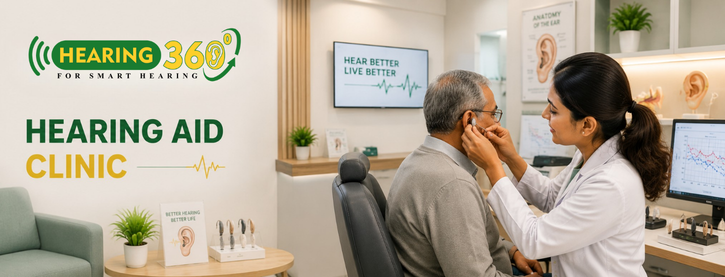
What You Can Expect From an In-Clinic Visit
A clinic brings a different set of advantages. It offers:
- A controlled testing environment, free from background noise
- A comprehensive audiological assessment where required
- Professional hearing-aid trial and fitting
- Detailed programming and fine-tuning
- Access to a wider range of hearing devices and accessories
- Evaluation when symptoms need further clinical investigation
For anyone with complex hearing concerns, this controlled setting often catches details a home visit simply can’t.
Background noise, room acoustics and access to specialised equipment all play a role in how accurate an assessment turns out to be.
Home vs Clinic: A Quick Comparison
| Factor | Home Visit | In-Clinic Visit |
| Convenience | High — no travel needed | Lower — requires travel |
| Assessment environment | Familiar, but less controlled | Controlled, sound-treated |
| Hearing-aid selection | Guided by real-life lifestyle | Wider device range available |
| Fitting and programming | Available where supported | Full-service, detailed |
| Follow-up support | Easy, low-effort | Requires repeat visits |
| Accessibility | Ideal for mobility challenges | Can be difficult for seniors |
| Advanced diagnostics | Limited | Fully available |
Table: Home Visit vs. In-Clinic Visit
Neither column wins outright. It comes down to what stage of care you need right now, and how much flexibility your family has for travel and scheduling.
Which Option Is Better at Each Stage of Hearing Care?
Instead of asking which is “better” overall, it helps to break the journey into stages. A hearing aid clinic visit makes more sense at some points, while home support works better at others.
First Hearing Test
The home tests work best when you want to have a basic understanding of your hearing ability, particularly for those who find travelling difficult.
In case the symptoms are unusual, like ringing, sudden hearing loss, or ear pain, in-clinic assessment is the best option for better treatment.
The individual’s specific symptoms should guide this decision more than personal preference alone.
A mild, gradual change in hearing rarely needs urgent clinical testing. A sudden change almost always does.
For Choosing and Fitting a Hearing Aid
This stage depends heavily on getting the fit right. Choosing a hearing aid means matching it to:
- The degree of hearing loss
- Daily communication needs
- Lifestyle factors, like phone use or noisy environments
- Device features such as connectivity and battery life
Buying a device isn’t enough on its own. Professional fitting, whether at home or in-clinic, makes the real difference.
Programming adjusts sound output to how the person actually hears, not just how a chart says they should hear.
At this stage, the trial periods become most important. Hearing aids often feel fine in a quiet space but may sound completely different in a crowded market or family gathering.
After initial use, the adjustments are what separate a device that’s worn daily from the one that sits in a drawer.
Hearing Aid Adjustments and Follow-Ups
Home visits become the winner when it comes to these follow-up and adjustment concerns. Regular adjustments don’t require you to visit the clinic. With home follow-ups, you can get:
- Troubleshooting and device checks
- Sharpening based on regular use
- Cleaning and maintenance
That said, if something more complex comes up- a persistent issue the audiologist can’t resolve remotely- a clinic visit may still be necessary.
Most families need this occasionally after the initial fitting is done.
Seniors and Families Handling Care
For elderly patients, home visits take away a lot of unwanted stress. Family members can get in, ask questions, and be involved in a way that is difficult to manage during a rushed clinic appointment.
It also removes the burden of repeated travel across Kolkata’s traffic, which matters more than people realise when appointments happen every few weeks.
What feels like a small errand to a younger family member can be genuinely exhausting for an elderly parent, especially after a long clinic wait.
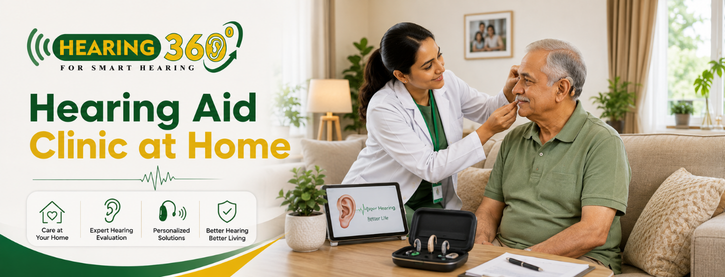
How Kolkata Families Can Decide Between Home and Clinic Care
There’s no universal answer here, but a few clear signals can guide the decision.
Looking honestly at your family’s routine and the person’s actual hearing needs usually points to the right choice faster than debating in the abstract.
Home Care for Accessibility and Convenience
Home care offers convenience that no clinical visit can. It works best when:
- Elderly person or person with limited mobility
- Travelling is tiring for the patient
- Regular follow-ups, instead of just one initial assessment
- Support or adjustment requirements
- Comfort with a familiar environment
In-Clinic Visit for Complete Evaluation
Clinic visit is the right choice when:
- Hearing issues spring up suddenly
- Portable tools cannot properly evaluate the condition
- There are complex hearing problems
- Advanced diagnostic testing is needed
Best Approach: A Combination of Both
Several families get the right results by combining both. An in-depth evaluation at a clinic, followed by a home visit and fitting — this works better than going with just one option.
The goal isn’t picking a side permanently. It’s continuity, making sure hearing care stays consistent, whether that happens at a hearing aid clinic in person or through a home visit.
Families who stay flexible about where care happens usually end up with better long-term outcomes than those who rigidly stick to one setting.
Get personalised hearing assessment, hearing-aid fitting, home visits and ongoing hearing-care support from Hearing Aids Kolkata.
Whether your family needs the convenience of a home visit or the depth of a full clinical evaluation, our audiologists help you choose the right path at every stage.
FAQs
- Is a home hearing aid clinic visit as effective as an in-clinic one?
For routine assessments, fittings and follow-ups, yes. Complex cases or advanced diagnostics usually still need an in-clinic evaluation.
- Can hearing aids be fitted and adjusted at home?
Yes, where the service supports it. Fitting, programming and ongoing adjustments can often be handled during home visits.
- When should I choose an in-clinic visit over a home visit?
Choose a clinic when symptoms are sudden, unexplained, or complex, or when advanced diagnostic equipment is needed.
- Is home hearing care suitable for elderly parents?
Yes. It reduces travel stress, lets family members participate, and works well for people with mobility challenges.
[…] Hearing Aid Clinic at Home vs In-Clinic: Which Is Better for Kolkata Families? […]