You hear the voice, but you miss the words. A restaurant, a phone call, a busy office: the problem shows up there first. A pure tone audiometry test finds the quietest sounds you can hear at each pitch.
As of 2025, the diagnostic accuracy for identifying the degree of hearing loss was about 70%.
With the PTA test, you can get this accuracy by understanding the decibels.
This guide explains what the decibel numbers mean, how to read the chart, and what to do with your results.
What Is a Pure Tone Audiometry Test and How Does It Work?
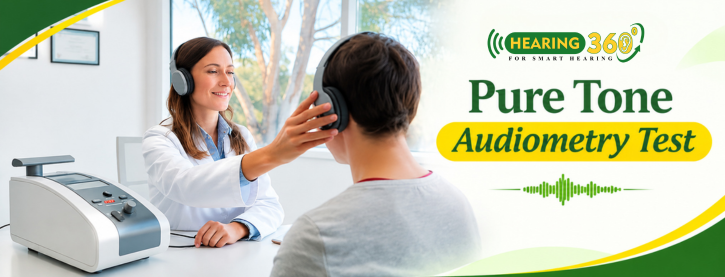
It is a hearing test that measures the softest tone you can detect at different pitches. You wear headphones in a sound-treated room.
You signal each time you hear a beep, even a faint one.
The audiologist records the lowest level you respond to at each pitch, and the test usually checks each ear separately.
The test uses two methods:
- Air conduction. Sound travels through headphones, then the outer ear, middle ear and inner ear.
- Bone conduction. A small vibrator behind the ear sends sound through the skull straight to the inner ear.
Comparing the two shows where a problem may sit: the outer or middle ear, the inner ear, or both.
The test relies on your responses, so attention and clear understanding of the instructions affect the results.
When do audiologists recommend it?
- You often ask people to repeat themselves
- You miss soft sounds like whispers or a doorbell
- Exposure to loud music or machinery
- Noisy spaces make conversations difficult
- You have ringing in the ears
- One ear hears less than the other
- You need to track hearing loss over time
A sudden change, particularly in one ear, needs urgent medical attention.
Do not wait for a routine test.
What happens during the test?
- Consultation. The audiologist asks about symptoms, ear infections, noise exposure and medical history.
- Ear check. They look at the ear canal and eardrum for wax or blockage.
- Setup. You are put in a quiet booth with the headphones on.
- Air conduction. Tones play at different pitches. The audiologist adjusts the level to find your threshold.
- Bone conduction. The vibrator goes behind your ear, and the process repeats.
- Results. Your thresholds go onto an audiogram, and the audiologist explains them.
The test is generally painless. Duration varies with the tests needed.
What Do Different Decibel Levels Mean in a Hearing Test?
Results appear in decibels hearing level (dB HL). A lower number means you hear softer sounds. The normal hearing level is around 20 dB HL.
A higher number means a sound must be louder before you notice it.
A reading of 0 dB HL is not silence. It is a standard reference for normal hearing.
Do not confuse dB HL with dB SPL. dB HL is a hearing threshold scale. dB SPL measures physical sound pressure.
They are not interchangeable.
This table uses the WHO 2021 grading.
It applies to the average threshold in the better ear at 500, 1,000, 2,000 and 4,000 Hz.
| Hearing level | dB HL range | What it may mean |
| Normal | Below 20 | Everyday speech is usually clear |
| Mild | 20 to below 35 | Soft speech and noisy settings get harder |
| Moderate | 35 to below 50 | Normal-volume conversation is hard to follow |
| Moderately severe | 50 to below 65 | You need louder speech to follow talk |
| Severe | 65 to below 80 | Speech is hard without strong amplification or support |
| Profound | 80 to below 95 | Only very loud sounds are detected |
| Complete | 95 or above | Very high degree of hearing loss |
Other professional systems use different cut-offs, so check which one your report uses. Also remember that this table describes an average in the better ear.
It does not describe each frequency or each ear. Two people with the same average can struggle in very different ways.
A number alone does not decide whether you need a hearing aid.
That depends on the full assessment, your communication needs and clinical advice.
How to read an audiogram
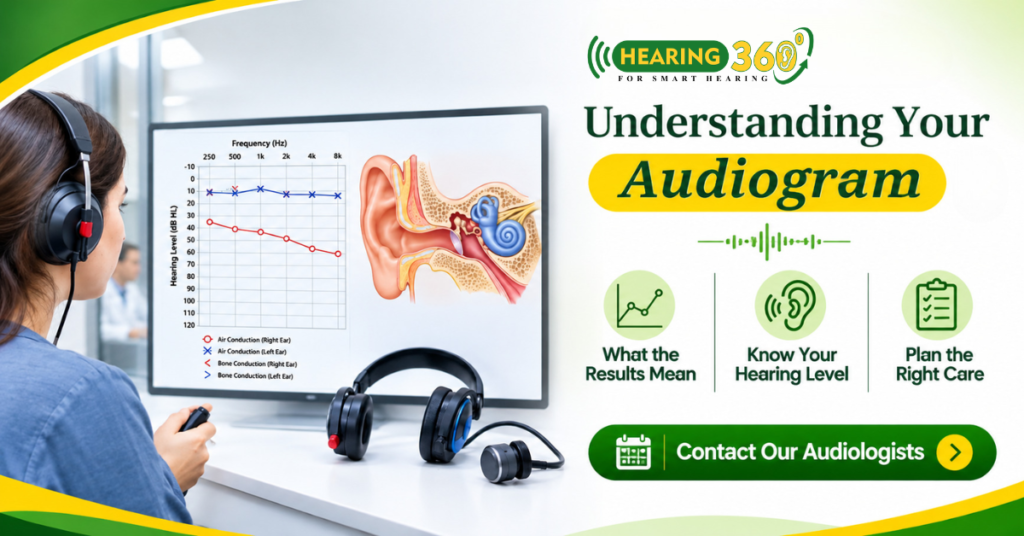
The audiogram checks the thresholds for each ear:
- Symbols: crosses and circles commonly mark left air conduction. Bone conduction involves different symbols. Check them because conventions may vary.
- Horizontal axis: pitch is measured in hertz. The lower pitches are on the left. High pitches usually sit on the right. The general test points run from 250 to 8,000 Hz.
- Vertical axis: loudness in dB HL. The softer sounds remain on the top. Thresholds lower on the chart indicate the need for louder sounds.
- Speech banana: a shaded area showing the typical pitch and loudness of everyday speech. Thresholds below it mean some speech sounds may be missed.
What your frequencies reveal
Pitch matters as much as loudness.
- 250 to 500 Hz: Low-pitched sounds and speech parts
- 1000 to 2000 Hz: the major frequencies for getting daily speech
- 4000 to 8000 Hz: high-pitched sounds including multiple soft consonants
Different vowels sit at lower pitches. The consonants often sit higher and remain quieter.
So someone with high-frequency loss may hear a voice but miss the words.
Common patterns include:
- Flat: similar thresholds across all pitches
- High-frequency: poorer thresholds at higher pitches
- Low-frequency: poorer thresholds at lower pitches
- Sloping or rising: thresholds shift gradually across pitches
The pattern shows the audiologist which sounds you miss and how that affects daily communication.

Types of Hearing Loss and Your Next Steps
The gap between air and bone results is called the air-bone gap.
It helps identify the type of loss.
- Conductive. Sound does not travel well through the outer or middle ear. Air conduction is poorer than bone conduction. Causes include wax, middle-ear fluid or eardrum problems.
- Sensorineural. The inner ear or hearing nerve is affected. Air and bone results are both reduced, usually with no large gap. Ageing and noise exposure are common causes.
- Mixed. Both types are present. Bone results are reduced, and air results are lower still.
An audiogram shows the type and degree of loss.
It does not always show the exact cause. You may need further examination.
What happens after your results?
The audiologist reviews both ears for degree, type, pattern and symmetry. They may compare your results with speech audiometry and other tests.
Depending on the findings, they may suggest:
- Further ear examination or a medical consultation
- More tests, such as impedance audiometry or OAE
- Follow-up audiograms to monitor change
- Hearing aids or other support, where appropriate
Choosing a hearing aid should reflect your hearing profile, lifestyle and comfort. The right hearing care clinic can offer you the right assessment.
Always have a qualified audiologist interpret your report. Do not self-diagnose from the numbers.
A pure tone audiometry test gives you more than one number. It shows which pitches you miss, in which ear, and why.
Read your dB HL levels alongside the full audiogram, and let an audiologist explain what they mean for daily life.
Looking for a hearing care clinic in Kolkata? Hearing 360 Degree in Garia offers pure tone audiometry to check the level, degree, and type of hearing loss.
FAQs
- What is a normal pure tone audiometry result?
Under the WHO 2021 grading, an average threshold below 20 dB HL in the better ear counts as normal hearing. Other systems use different cut-offs, so the definition depends on the classification and clinical context. - What does 30 dB mean in a hearing test?
It is a hearing threshold, not the loudness of an everyday sound. It means you needed a tone at 30 dB HL to hear it. Its meaning depends on the pitch and the classification used. - Is the test painful?
No. It is generally painless. You listen to tones and respond when you hear them. You need to stay attentive and follow instructions. - How long does it take?
It varies with the tests needed. A basic assessment is usually completed in a single short appointment. Your audiologist can give you an estimate. - Can it detect hearing loss in one ear?
Yes. Each ear is tested separately, so the test can show one-sided or uneven hearing loss. - Does a normal audiogram mean perfect hearing?
Not always. A normal result is reassuring, but it does not rule out every difficulty, such as trouble understanding speech in noise. Speech tests can add more detail.