
When the room spins and nobody can say why, an electronystagmography test may help point the way.
It records your eye movements, and those movements often show what your balance system is doing.
Your eyes, inner ear, and brain work as a team. When one part slips, your eyes can jerk in ways you cannot feel.
The ENG Test market in India is expected to grow to 5.6 billion dollars by 2035. This growth indicates a rising demand, which requires patients to understand what it is and what it includes before they book one.
This guide explains what ENG measures, what the appointment involves, how to prepare, and what your results can and cannot tell you.
What Does an Electronystagmography Test Measure?
ENG uses small electrodes placed around your eyes. They pick up electrical changes as your eyes move.
A clinician then looks for nystagmus, an involuntary, rhythmic eye movement that can signal a problem in the balance system.
Why do eye movements matter?
Your inner ear senses head motion.
Your brain processes that signal.
Your eyes then adjust so the world stays steady.
When any link breaks, the eyes can give it away.
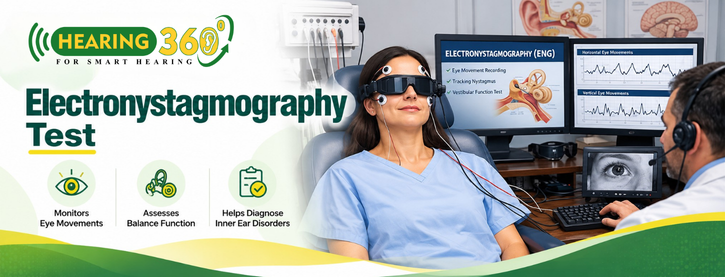
What does the Test Look At?
ENG gathers information about three things:
- Eye movement control: how well your eyes follow and hold targets
- Nerve pathways: the connections between brain, ear and eye muscles
- Inner-ear vestibular function: the way the ear responds to stimulation
Doctors usually recommend an ENG test when vertigo, dizziness, unsteadiness, or unexplained hearing loss needs a closer look.
It may play a role when they suspect BPPV, Ménière’s disease, vestibular neuritis, labyrinthitis, or an acoustic neuroma.
It does not diagnose any of these alone. It adds one piece to the picture.
What Does the Test Include?
ENG involves a set of tasks and not just a single measurement.
Protocols may depend on the centre.
- Gaze test: you look ahead and to the sides while the system observes it and finds if there’s any drifting.
- Calibration: you look at a light, and the system captures your eye movement
- Pendulum tracking: you follow a moving target.
- Optokinetic test: you watch moving patterns while your head stays still.
- Positional testing: your head or body changes position while your eyes are recorded.
- Caloric testing: Each ear is stimulated by cold or warm air or water
Caloric testing raises the most questions. Warm and cool air or water goes into each ear canal, one at a time.
The clinician compares the response from each side.
A big difference between ears can suggest a problem on one side. Spinning or nausea during this step is expected, and it passes.
What to Expect During an ENG Appointment
How to Prepare?
Preparation differs between centres, so follow your centre’s instructions first. Common advice includes:
- Tell the provider about all medicines and supplements. Some can affect results.
- Never stop a prescribed medicine unless your provider says so.
- Ask about food, caffeine, and alcohol. Some centres ask you to avoid them for several hours.
- Mention any ear problems, such as a perforated eardrum or ear surgery.
- Carry your hearing aids and glasses if you have them.
Wear comfortable clothes. Skip face cream and heavy makeup around the eyes on the day, since the patches need clean skin to stick well.
If you have long hair, tie it back so it stays off your forehead.
Is ENG Safe?
For most people, yes. It is non-invasive, and nothing goes into your body except air or water in the ear canal during caloric testing.
The main caution involves the eardrum. Water-based caloric testing is not suitable if the eardrum has a hole in it.
Tell the clinician about any ear surgery, discharge, or past perforation before you start. They may use air instead or skip that part.
Step by Step Process
Here are the usual electronystagmography test steps:
- Check-in: the clinician reviews the symptoms, current medications and the overall ear condition
- Electrodes: the skin is cleaned, and patches are put around the eyes and on the forehead. It is a no-needle process. The patches feel cool and sticky, and you keep your eyes closed.
- Eye tasks: you follow lights, look in different directions, and track moving targets. The first task, calibration, takes only a minute or two.
- Positioning: you change head and body positions while your eyes are recorded.
- Caloric stimulation, if included: each ear is tested separately.
- Wrap-up: the electrodes come off, and any sticky residue is cleaned. If you feel dizzy or sick, staff may ask you to rest first.
How Long It Takes and Is It Invasive?
Most ENG appointments take about 1 hour and 30 minutes. The precise timing depends on the part your clinician performs.
This is a non-invasive test. Removing patches can tug your skin. Positioning may cause some dizziness. Caloric testing may also cause nausea and spinning, which can go away within some time.
Many people get released from the clinic on the same day. If you’re worried, bring someone with you. Tell the staff in case the symptoms last.
Plan your day around the visit. Book a time when you are not rushed. After caloric testing, wait a few minutes before you stand up quickly, and avoid travelling alone if you feel unsteady.
Understanding Your Results and Next Steps
What ENG Results Mean?
A normal result means that your eyes responded as expected when parts were performed. Normal ranges may differ a little between laboratories.
An abnormal result points to a problem in eye movement control, the inner ear, or the nerve pathways. It does not name a disease.
It does not automatically mean something serious. And a normal result does not rule out every cause of dizziness.
That is why doctors read ENG alongside your history, examination, and hearing tests.
A tertiary-care study from West Bengal found that ENG added useful information when combined with other clinical and audiological assessments. The usual path looks like this:
- Symptoms and medical history
- Clinical examination
- Vestibular tests, where appropriate
- Interpretation of all findings
- More testing, if needed
- Diagnosis and treatment plan
An electronystagmography test works best as one step in that chain, not as a final verdict.
ENG vs VNG: What is the Difference?
Both ENG and VNG tests record eye movements and give similar information about inner-ear and nerve function.
The difference lies in how they record.
| Feature | ENG | VNG |
| Recording method | Electrodes | Infrared video goggles |
| What is captured | Electrical changes linked to eye movement | Camera images of the eyes |
| Main purpose | Vestibular and eye-movement assessment | Vestibular and eye-movement assessment |
| Availability | Depends on the centre | Depends on the centre |
Table: ENG vs. VNG
Which one you are offered depends on the equipment, the clinic’s protocol, your circumstances, and clinician preference.
Neither is better for everyone.
What to Ask Before Booking in Kolkata?
“ENG” does not mean the same package everywhere.
Before you book, ask:
- Which components are included?
- Is caloric testing included?
- Is the report included, and when will it be ready?
- Is the consultation charged separately?
- What preparation do I need?
- Can the report be shared with my referring doctor?
Bring any previous reports, your medicine list, and hearing or balance records.
They help the clinician read your results in context.
An electronystagmography test records eye movements to show how your balance system and its nerve pathways are working.
The parts vary by centre, the appointment takes about 90 minutes, and the results only make sense alongside your history and other tests. Knowing this makes the visit far less stressful.
If dizziness or hearing changes are troubling you, book a hearing and balance evaluation at Hearing 360 Degree.
Our team will explain each test before it begins, so you know what to expect.
FAQs
- What is an ENG test used for?
Doctors use it to help evaluate dizziness, vertigo, balance problems, and some hearing or inner-ear concerns. It looks at how your eyes, inner ear, and related nerves work together. - Is an ENG test painful?
No, it is non-invasive. Removing the electrode patches may tug your skin. Some parts, especially caloric testing, can cause brief dizziness or nausea. - Can ENG make you feel dizzy?
Yes. Positional and caloric testing can trigger short spells of spinning or nausea. These usually pass within minutes. Tell the staff if they continue. - What should I avoid before an ENG test?
It depends on your centre. Some ask you to avoid food, caffeine, or alcohol for several hours. Only change your medicines if your provider tells you to. - What does an abnormal ENG result mean?
It means your eye movements or vestibular responses differed from the expected pattern. It does not give a final diagnosis. Your doctor will read it with your symptoms and other tests. - Can ENG diagnose the cause of vertigo?
It gives useful information, but it does not diagnose alone. Doctors combine it with your history, examination, and hearing tests.