
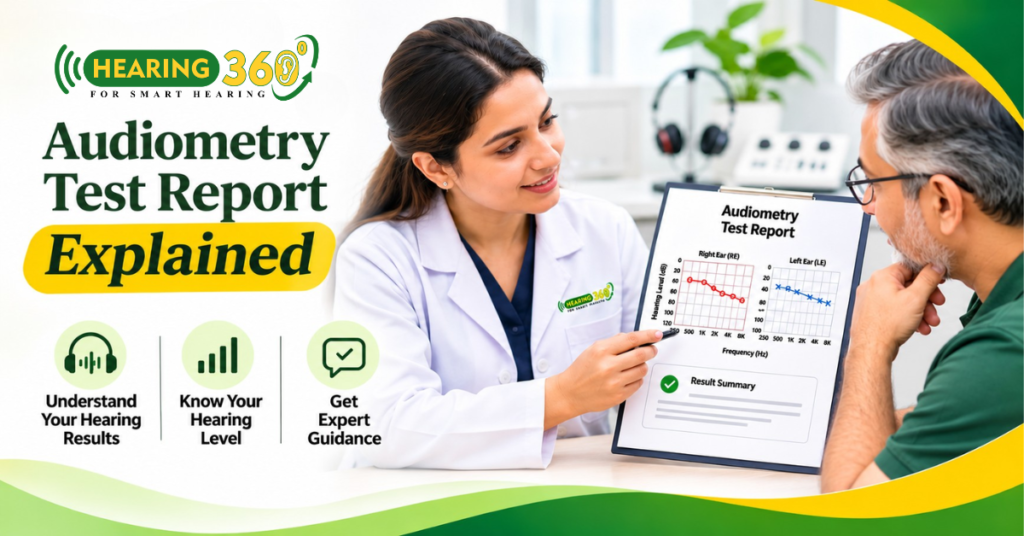
Your audiometry test report arrives, and the graph looks like a secret code—Xs, Os, and a downward-sloping line.
As the WHO report shows, around 63 million Indian people have hearing impairment.
But the kind of hearing loss they experience is identified with an accurate test report.
A pure-tone audiometry test creates that graph, and a few simple rules make it easy to read.
This guide shows you how to spot conductive and sensorineural hearing loss, and what to do next.
How to Read Your Audiometry Test Report
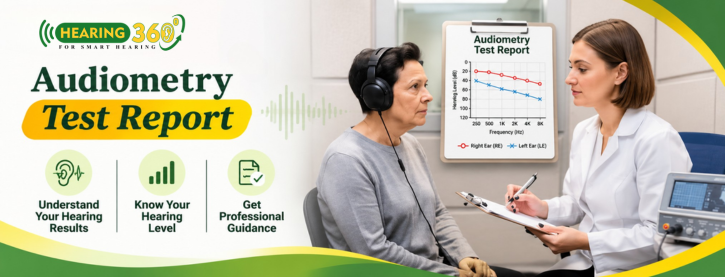
An audiogram plots the softest sounds you can hear at each pitch. Pitch runs left to right, from low to high. Loudness runs top to bottom.
Points near the top mean you hear sounds more easily.
Points lower down mean a sound must be louder before you notice it. Each ear gets its own line.
Check the two axes
- Horizontal axis: Frequency in hertz (Hz). Low pitches like a drum sit on the left. High pitches like a bird’s chirp sit on the right.
- Vertical axis: Hearing level in decibels (dB HL). Higher numbers mean poorer hearing.
Here is a simple example. Someone may hear low tones at 20 dB HL and high tones at 60 dB HL.
That person hears men’s voices fine.
But they miss the “s” and “f” sounds, so speech feels muffled.
Find the symbols for each ear
Most reports mark the right ear in red and the left ear in blue. Air conduction and bone conduction use different symbols.
Always check the legend on your report. Symbol styles vary between clinics.
Follow four steps
- Find the right-ear and left-ear lines.
- Note where each line sits. Anything beyond about 25 dB HL suggests some hearing loss.
- Compare air-conduction points with bone-conduction points.
- Check whether both ears match.
Look at the shape
Shape matters as much as depth. Your audiologist will look for these patterns:
- Flat: Similar loss at every pitch.
- Sloping: Good low-pitch hearing that drops at high pitches.
- Rising: Poorer low-pitch hearing.
- Notched: A dip at one frequency, often linked to loud noise.
One average number can hide these patterns.
Someone can have a “mild” average and still struggle to follow speech in a crowd.
Conductive vs Sensorineural Hearing Loss: What the Audiogram Shows
Conductive hearing loss comes from a problem in the outer or middle ear.
Sensorineural hearing loss comes from the inner ear or the hearing nerve.
The audiogram separates them by comparing air conduction with bone conduction.
Air conduction vs bone conduction
Air conduction sends sound through the whole ear. Bone conduction uses a small vibrator on the skull.
It skips the outer and middle ear and goes straight to the cochlea.
Pure-tone audiometry tests measure both. The gap between them tells the story.
The air-bone gap is the difference between your air and bone results. A meaningful gap points to a problem in sound transmission.
Quick comparison
| Feature | Conductive | Sensorineural |
| Area affected | Outer or middle ear | Inner ear or hearing nerve |
| Air-conduction results | Poorer | Poorer |
| Bone-conduction results | Often normal or near normal | Usually poorer |
| Air-bone gap | Usually present | Usually absent |
| Common causes | Earwax, middle-ear fluid, eardrum hole, otosclerosis | Ageing, loud noise, some medicines, genetic or inner-ear conditions |
These are typical patterns, not diagnoses.
What conductive loss looks like
Air-conduction points drop. Bone-conduction points stay near the top. The space between them is the air-bone gap.
Sound is reaching the inner ear, but something blocks the path.
Earwax is a common culprit.
Fluid behind the eardrum is another common cause, especially after an ear infection.
What sensorineural loss looks like
Both air and bone points drop together. They sit close, so there is no real gap. The inner ear is not picking up sound well.
Many people with age-related or noise-related loss show a slope toward the high pitches. That pattern is common, but it does not prove the cause.
What mixed loss looks like
Mixed loss combines both. Bone-conduction points are lowered, and air-conduction points sit even lower.
Picture a person with long-term noise damage who also develops a middle-ear infection. Both parts matter for treatment.
Why one report cannot name the cause
A single audiometry test report shows the pattern, not the reason.
Different conditions can look alike on the graph.
Your clinician combines the report with your symptoms, history, and an ear examination. Please do not try to diagnose yourself from the graph.
What to Do After an Abnormal Result
Start by booking a follow-up with an audiologist or an ENT specialist.
The audiologist explains your results and tests your hearing in more detail.
The ENT checks for medical causes. Many people see both.
Tests that fill in the picture
Not everyone needs every test. Your clinician picks what fits your results.
- Otoscopy: Examines the ear canal and eardrum.
- Tympanometry: Checks how well the eardrum and middle ear move.
- Speech audiometry: Shows how well you understand words, not just beeps.
- Otoacoustic emissions (OAE): Tests the cochlea’s outer hair cells.
- Auditory brainstem response (ABR/BERA): Tracks nerve signals when more detail is needed.
How treatment differs
Conductive loss: Some causes are treatable. A clinician can remove earwax. Fluid or infection may need medicine. Certain structural problems, such as otosclerosis or a perforated eardrum, may need surgery.
Sensorineural loss: Hearing aids are the most common support. They improve access to speech and daily sounds. They don’t repair the inner ear—communication strategies and auditory rehabilitation also help. People with severe loss may be assessed for other hearing technologies.
Is hearing loss reversible? It depends on the cause. Many conductive problems improve with treatment. Sensorineural loss is often permanent, but not always. Avoid assuming either way.
Know the urgent signs
Get medical help quickly if you notice any of these:
- Hearing drops over hours or a few days.
- One ear suddenly sounds muffled or dead.
- Hearing loss comes with severe dizziness or new numbness, weakness, or speech trouble.
Do not wait for a routine appointment. Sudden hearing loss needs prompt assessment.
Choose your clinic with care
If you live in Kolkata, you have many options. Look past the signboard. Ask these questions:
- Does the clinic test both air and bone conduction?
- Will a qualified audiologist explain your results face-to-face?
- Can they run tympanometry or speech tests when needed?
- Can they refer you to an ENT specialist?
- Do they offer follow-up support, including hearing aid trials?
A good clinic answers these clearly. They will also tell you when you don’t need a hearing aid.
Reading a graph gets easier once you know the three things to check. Look at the shape, compare air with bone, and find the gap.
That simple method separates conductive, sensorineural, and mixed loss. Your audiometry test report is a starting point, not a final verdict.
Pair it with an expert’s opinion before you decide on treatment.
If a pure-tone audiometry test has left you with questions, don’t guess.
Contact Hearing 360 Degree to discuss your results and the next steps that suit your hearing needs.
FAQs
Can a hearing test result show the type of hearing loss?
Yes. Comparing air-conduction and bone-conduction results helps separate conductive, sensorineural, and mixed loss. Your clinician also considers symptoms and examination findings.
What does an air-bone gap mean?
It means air-conduction results are poorer than bone-conduction results by a meaningful amount. This often points to a conductive component. A full assessment confirms what it means for you.
Can conductive hearing loss be treated?
Often, yes. Some causes respond to cleaning, medicine, or surgery. The outcome depends on the underlying condition.
Is sensorineural hearing loss permanent?
It is often permanent, especially when sensory cells in the cochlea are damaged. Causes and options vary. Sudden loss needs urgent medical attention.
Do I need a hearing test if I hear some sounds normally?
Possibly. Hearing can differ by pitch and by ear. Normal hearing for some sounds does not rule out loss at others.
Should I see an audiologist or an ENT after an abnormal result?
An audiologist measures hearing and explains the results. An ENT looks for medical causes. Many people need both.