
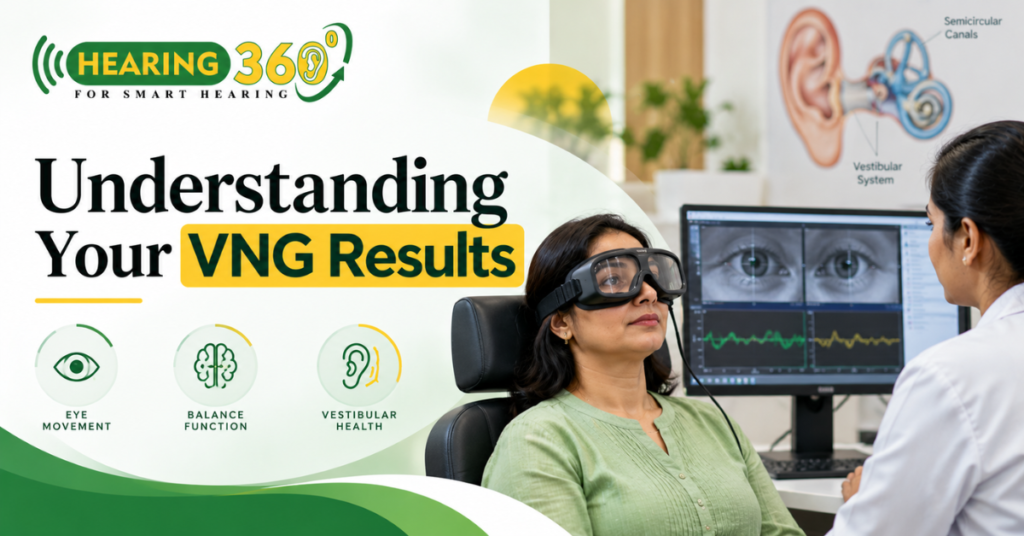
One word on a report can ruin your evening: abnormal. A VNG ear test tracks your eye movements to check how your balance system works.
An abnormal result is a clue, not a diagnosis. Doctors order videonystagmography (VNG) for recurring dizziness, vertigo and unsteadiness.
VNG is considered a useful test, helping with around 75% of diagnoses.
This blog explains what common findings may mean, which conditions they may link to, and what to ask your clinician next.
What Does an Abnormal VNG Ear Test Result Mean?
An abnormal result means one or more parts of the test showed an unusual eye-movement response. It does not name a disease.
Your clinician reads each finding alongside your symptoms, medical history and ear examination.
Sometimes other tests are needed too.
VNG records involuntary eye movements, called nystagmus, under different conditions.
Your eyes, inner ears and brain work together to keep you steady.
When that link falters, your eyes often show it.
That is why eye movements give clues about balance.
Findings usually fall into four broad groups:
- Peripheral findings: may point to the inner-ear balance organs or their nerve pathways.
- Oculomotor findings: may suggest a problem with eye-movement control, sometimes involving central pathways.
- Positional findings: eye movements triggered by head or body position. They help assess positional vertigo.
- Normal or inconclusive findings: these do not explain every dizzy episode.
These are categories, not diagnoses.
A VNG alone cannot explain every balance problem. To learn how the test itself works, see VNG testing and vestibular assessment.
Common Abnormal VNG Findings and What They May Suggest
Each test component answers a different question.
Here is how to read the main ones.
Nystagmus during Testing
Nystagmus means repeated, involuntary eye movements. They can be horizontal, vertical or rotational.
As per a study conducted in 2021, 41.2% of participants and 10 controls showed nystagmus after a high-frequency headshake test.
The clinician notes when they appear: at rest, during gaze testing or after a position change. Direction, timing and strength all matter.
So does whether looking at a fixed target calms them.
Many inner-ear conditions cause nystagmus.
Some patterns raise concern about the central nervous system. Nystagmus alone never names a specific disease.
Context decides the meaning.
Abnormal Caloric Results
Caloric testing involves using cool and warm air to stimulate the balance response of each ear.
Research shows that 53.6% of cases with predominant unilateral weakness have been observed as abnormalities on caloric testing.
The clinician then compares both sides.
- Unilateral weakness: one ear responds less. This may suggest reduced function on that side.
- Bilateral weakness: both ears respond weakly. This may prompt further vestibular assessment.
- Directional preponderance: responses run stronger in one direction. Clinicians read it with the rest of the test.
Test quality, ear conditions and technical factors also count.
A weak response alone does not give the underlying cause.
Smooth Pursuit and Saccade results
In smooth pursuit, your eyes follow a moving target.
In saccades, they jump between targets.
Irregular tracking may signal trouble with eye-movement control. Sometimes it raises suspicion of central involvement.
But age, attention, vision, medication and unclear instructions can all affect results.
Clinicians weigh these factors before concluding.
Abnormal tracking cannot diagnose a neurological condition.
Abnormal Positional Testing
Positional testing checks whether certain head or body positions trigger eye movements.
A characteristic response may support an assessment for benign paroxysmal positional vertigo (BPPV).
The direction and timing of the movement, plus your symptoms, show whether the pattern fits.
Not every positional abnormality means BPPV. Clinicians read the full pattern, not just the word “positive.”
Abnormal Optokinetic Testing
This test tracks your eye movements as you watch a moving visual pattern.
An odd response may lead to a closer look at eye-movement control.
Yet an isolated abnormal result is not proof of a central balance disorder. Testing limitations can cause it too.
Which Conditions can Link to Abnormal Findings?
A simple finding isn’t a diagnosis. A VNG ear test may influence multiple diagnoses but isn’t the only deciding factor.
Check the table below for some possibilities.
Two people with the same condition may have different results.
| Condition | How VNG may contribute | Important qualification |
| BPPV | May record characteristic positional eye movements | Diagnosis depends on the pattern and clinical assessment |
| Vestibular neuritis | May show reduced responses, including caloric weakness | Read alongside symptom history and examination |
| Ménière’s disease | May reveal vestibular abnormalities in some patients | VNG alone cannot confirm it |
| Vestibular migraine | May show abnormalities in some tests | Diagnosis relies heavily on clinical criteria |
| Central vestibular disorders | Some oculomotor findings may prompt neurological evaluation | An abnormal VNG does not establish a neurological diagnosis |
Table: VNG test for different conditions
What Should You Do After an Abnormal VNG Report?
Review the Findings with a Clinician
Ask a qualified clinician to link the findings to your symptoms, history and ear examination.
Treatment depends on the cause, not on the word “abnormal.”
Care may include condition-specific treatment, positional manoeuvres or vestibular rehabilitation.
No single treatment fixes every type of dizziness.
Ask If more Tests are Needed
Not everyone needs further testing. After a VNG ear test, your clinician may consider:
- A hearing assessment, if you also notice hearing changes or tinnitus.
- Additional vestibular tests to check other parts of balance function.
- Neurological assessment or imaging, when the clinical picture calls for it.
The decision depends on your case, not on the report alone.
Can a Normal Result Still Come with Dizziness?
Yes. VNG checks specific eye-movement and vestibular responses. It does not cover every cause of dizziness.
Some conditions leave no trace during the test.
Symptoms may also come and go.
A normal result is useful information. Persistent dizziness still deserves proper assessment.
When to Seek Urgent Care
Do not wait for an appointment if dizziness is sudden and comes with trouble speaking, weakness, double vision, inability to walk safely, fainting or a severe new headache.
Get urgent medical help. This advice is separate from reading any VNG report.
Questions to Ask Your Clinician
Bring this list to your appointment:
- Which part of my test was abnormal?
- Does it suggest reduced function in one ear, both ears or eye-movement control?
- Could medication, vision or test limitations have affected it?
- Does the finding match the timing and triggers of my symptoms?
- Do I need another test or a follow-up visit?
- What should I do if dizziness continues despite a normal result?
Treat your result as a starting point. A VNG ear test gives clues.
Your clinician puts them together.
If you have a report you cannot make sense of, or dizziness that will not settle, Hearing 360 Degree can guide you through its hearing care and balance assessment services.
Contact the team to ask questions. Do not self-diagnose from a report or a blog.
FAQs
What does an abnormal VNG result mean?
It means one or more test parts showed an unusual response. The meaning depends on the specific finding and your symptoms.
Can an abnormal VNG result mean an inner-ear problem?
Yes, it may point to a vestibular problem in the inner ear. A clinician still needs to interpret it with your history and examination.
Does an abnormal VNG mean I have a neurological disorder?
No. Some findings may prompt a check of central pathways. An abnormal VNG alone does not confirm a neurological diagnosis.
Can VNG detect BPPV?
VNG may record eye movements during positional testing that support an assessment for BPPV. Your clinician reads them alongside the examination.
What if my VNG results are normal but I still feel dizzy?
VNG does not assess every cause of dizziness. Discuss ongoing symptoms with a qualified clinician.
Do I need another test after an abnormal VNG?
Not always. It depends on the result, your symptoms, your history and your clinician’s judgment.