
Your ear feels blocked, and voices sound muffled. A PTA impedance test can show whether the problem lies in how you hear or in how your ear carries sound.
These symptoms look alike, but they do not share one cause.
Earwax, fluid, a stiff eardrum or inner-ear damage can each make sound feel dull.
0.3% of the population suffers from hearing disability in India.
One result rarely separates them. That is why audiologists often use two tests side by side.
This guide explains what each test checks, how the results fit together and what to expect on the day.
Why One Hearing Test May Not Tell the Whole Story
Hearing involves two separate questions. How softly can you detect a sound?
And how well does your middle ear pass that sound along?
Pure tone audiometry answers the first question. Impedance audiometry answers the second.
Together, they give an audiologist a fuller picture than either test gives alone.
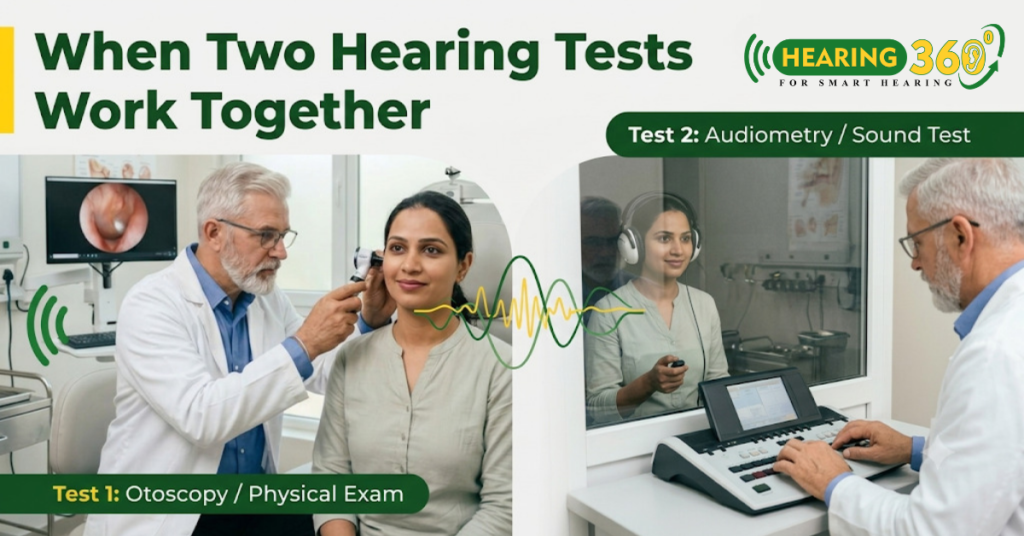
Hearing Ability and Middle-Ear Function Are Different
Sound enters the outer ear and strikes the eardrum. Three tiny bones in the middle ear then pass the vibration on to the inner ear.
Nerves carry the signal to the brain. A fault at any step can reduce hearing.
Pure tone audiometry (PTA) measures hearing thresholds.
These are the softest tones you can detect at different pitches.
Impedance audiometry looks at the eardrum and the middle ear.
It checks how they respond to sound and changes in air pressure.
The two tests ask different questions.
One asks, “How well do you hear?” The other asks, “How well does the middle ear work?”
Similar Symptoms Can Have Different Causes
Take four common complaints:
- Muffled hearing. Wax, fluid behind the eardrum or inner-ear changes can all cause it.
- Trouble following conversations. This may come from the outer, middle or inner ear. Noisy rooms make it worse.
- A feeling of fullness or blockage. It often points toward pressure problems in the middle ear, but not always.
- Reduced hearing in one ear. The cause varies, so it needs a closer look.
Symptoms alone cannot tell you the cause. Tests narrow it down.
What Does a PTA Test Reveal About Your Hearing?
A PTA test shows the softest sounds you can hear at different pitches.
It also helps show whether any hearing loss starts in the outer and middle ear or in the inner ear.
How Pure Tone Audiometry Works
You sit in a quiet room and wear headphones. The audiologist plays tones at different pitches and volumes.
You press a button or raise your hand each time you hear one.
Some tones will be very soft, so respond even if you are not sure.
The test uses two routes:
- Air conduction. Sound travels through the whole ear, from the outer ear to the inner ear.
- Bone conduction. A small vibrator sits behind the ear. It sends sound straight to the inner ear and skips the outer and middle ear.
Comparing the two routes is the key.
It shows where sound loses strength.
The audiologist records your responses on an audiogram.
This graph shows the softest sound you heard at each pitch.
Understanding the Three Main Types of Hearing Loss
| Type | What the results generally indicate |
| Conductive | A problem affecting sound transmission through the outer or middle ear |
| Sensorineural | A problem involving the inner ear or the auditory pathway |
| Mixed | A combination of conductive and sensorineural components |
PTA helps assess the degree and type of hearing loss.
But an audiogram never stands alone.
The audiologist reads it alongside your history, an ear examination and other findings.
What Does an Impedance Audiometry Test Check?
Impedance audiometry checks how well your eardrum and middle ear move and respond.
It does not measure how softly you hear. The main part of the test is called tympanometry.
Understanding Tympanometry
The audiologist places a small, soft probe at the opening of your ear canal.
It seals the canal. The probe then changes the air pressure gently and plays a tone.
At the same time, it measures how the eardrum moves.
You only need to sit still. You do not need to respond to anything.
The result appears as a graph called a tympanogram. It describes middle-ear function.
Some clinics also add acoustic reflex testing, which checks how the middle-ear muscle reacts to loud sound.
What Can the Results Help Identify?
The tympanogram can give clues about:
- How freely the eardrum moves
- Pressure inside the middle ear
- Possible fluid behind the eardrum
- Possible Eustachian tube dysfunction
- Other middle-ear changes that need a clinical check
Remember the limits. One impedance result does not confirm a specific disease.
It points the audiologist toward what to examine next.
How a PTA Impedance Test Shows the Full Picture
When PTA and impedance results are read together, they show both how well you hear and why.
One test describes the hearing loss.
The other helps explain where the trouble may sit.
When PTA Shows a Conductive Component
An air-bone gap appears when air conduction results are worse than bone conduction results.
In simple terms, sound reaches the inner ear fine when it bypasses the outer and middle ear, but it struggles to get there the usual way.
That suggests a conductive component.
This is where a PTA impedance test earns its place. The audiogram shows that something blocks or weakens sound.
Tympanometry then checks whether the eardrum and middle ear move as they should.
It adds information the audiogram cannot give on its own.
When the Results Do Not Tell the Same Story
Sometimes the two tests agree. Sometimes they do not. Both situations are useful.
| PTA findings | Impedance findings | What the combination may suggest |
| Conductive component | Abnormal tympanogram | A possible middle-ear contribution |
| Conductive component | Normal tympanogram | Further clinical assessment may be needed |
| Sensorineural pattern | Normal tympanogram | Findings may point away from a middle-ear explanation |
| Mixed hearing loss | Abnormal tympanogram | Both middle-ear and inner-ear components may be involved |
These are illustrative patterns, not diagnostic rules.
The audiologist also weighs your history, an ear examination and other test results before drawing any conclusion.

Who May Need a PTA Impedance Test?
An audiologist may suggest both tests if you notice any of these:
- Muffled hearing that does not go away
- Signs of a conductive hearing difficulty
- A blocked-ear feeling that keeps coming back
- A child who needs a hearing assessment, when clinically indicated
- A need for further assessment before a hearing aid recommendation
Not everyone needs both tests. The audiologist chooses based on your symptoms and clinical findings.
What Happens During a PTA and Impedance Assessment?
The visit follows a simple order:
- The audiologist asks about your hearing concerns and relevant history.
- The ear may be examined before testing begins.
- PTA measures your hearing thresholds using air and bone conduction.
- Impedance testing assesses middle-ear function.
- The audiologist reviews the results with you and explains the next steps.
Testing time varies from person to person, so do not expect a fixed duration.
Neither test is meant to be painful. You may feel slight pressure during tympanometry.
Many people search for PTA test for ear cost in Kolkata before booking.
Fees depend on the clinic and on which tests you need. Ask before you go, and confirm what the fee covers.
If you want a hearing test in Kolkata, look for a clinic that offers more than one type of assessment. Your symptoms decide which tests make sense.
PTA tells you how well you hear. Impedance audiometry tells you how well the middle ear works.
Neither answers every question alone.
A PTA impedance test helps an audiologist match your symptoms to the likely area of the problem, so the next step is clearer.
If muffled hearing or a blocked-ear feeling will not go away, do not wait. Contact Hearing 360 Degree to enquire about the right hearing assessment for you.
FAQs
- Is PTA the same as a regular hearing test?
PTA is the most common hearing test, but it measures only hearing thresholds. Impedance audiometry checks the middle ear. They assess different parts of the hearing system.
- Does impedance audiometry measure hearing ability?
No. It measures how the eardrum and middle ear respond to pressure and sound. It does not show how softly you can hear.
- Why are PTA and impedance tests sometimes recommended together?
PTA shows the type and degree of hearing loss. Impedance testing adds information about the middle ear. Together, they help the audiologist decide what to look at next.
- Are these tests painful?
Both are generally non-invasive. You wear headphones for PTA. For tympanometry, a soft probe sits at the ear opening, and you may feel mild pressure.
- Can these tests find the exact cause of hearing loss?
Not on their own. The results guide further evaluation. The audiologist or doctor also considers your history and an ear examination.
- Do children need both tests?
Not always. The choice depends on the child’s age, symptoms and clinical needs. The audiologist decides which tests suit your child.